Brentwood · Oakley · Antioch
Stucco Crack Repair in Brentwood, CA
Almost every stucco wall cracks eventually. What matters is which cracks are cosmetic, which are letting water in and which point to something moving behind the wall. Here is how to tell them apart and what fixing each one involves, for homes in East Contra Costa.
Seeing stains, bubbling or soft spots with the crack? Water may already be inside. See stucco water damage repair.
Why stucco cracks
The Stucco Manufacturers Association groups cracks into two kinds. Shrinkage cracks develop as excess water evaporates from the drying cement mix, or when it dries too fast on a hot, windy day. Structural cracks come from stress passed into the plaster from outside: ground movement and settlement, foundation settlement, movement in the wood frame, framing or shear-panel problems, and wind or live loads (Stucco Manufacturers Association). The same paper says minor cracking at the corners of doors and windows and other stress points is reasonable and should be anticipated.
The common crack patterns
Hairline and straight cracks
Thin cracks that run in a fairly straight line are the most common. Sto treats cracks up to about 1/32 inch as hairline and says they should be addressed when they are unsightly or let in enough water to cause deterioration (Sto). Angi's repair-or-replace guide describes hairline cracks under 1/16 inch and spider-web patterns from improper curing as repair candidates (Angi). The two sources draw the line at slightly different widths, which is a good reason to ask a contractor to look rather than rely on a ruler.
Map or spider-web cracking
A network of fine cracks across a section of wall often traces back to how the stucco cured. It is usually cosmetic, but a network that has opened up or is stained at the lines is worth checking for water.
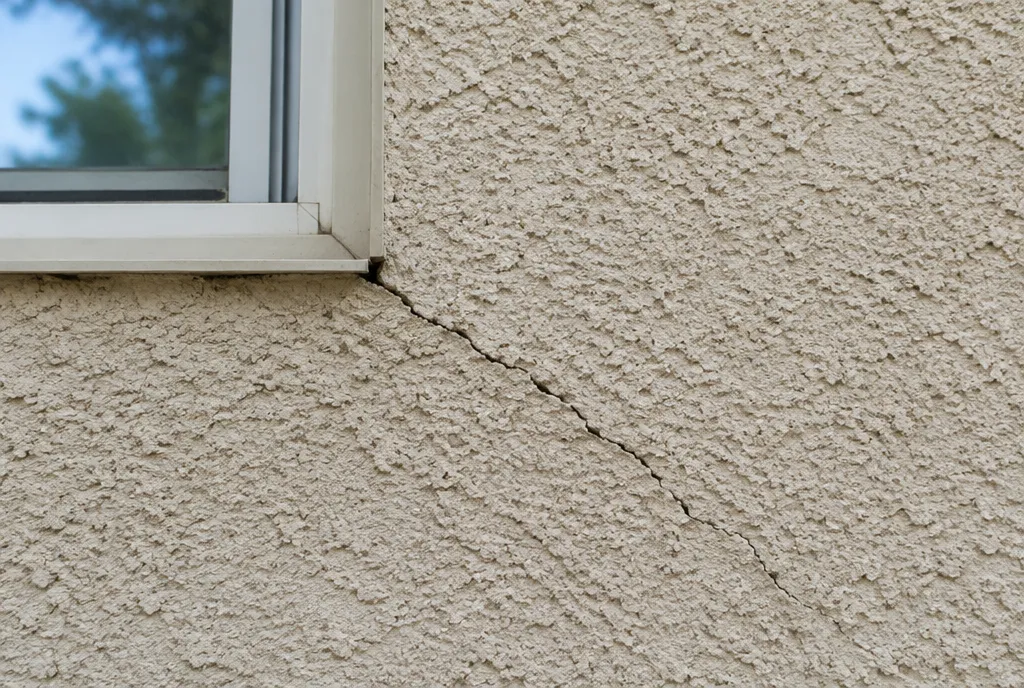
Diagonal cracks at window and door corners
Corners are where stress concentrates, which is why the industry expects some cracking there. A diagonal crack from a corner that keeps widening, reopens after being fixed, or comes with a sticking window or door is a different story and may be about movement in the framing.
Cracks that line up with the foundation or run across a whole wall
Cracks that follow the foundation line or run across a whole wall can reflect settlement or frame movement. They are not a coating problem, so painting or filling them tends to be temporary. A contractor, and sometimes a structural professional, should look first.
When a crack needs repair
The Stucco Manufacturers Association recommends patching a crack that is visible from more than 10 feet away or is a source of leaking. Some signs point to water rather than looks: Sto lists blistering, bubbling, white mineral deposits (efflorescence) and peeling finishes as indicators of water getting in. Tapping the wall can also help; InterNACHI describes using a wooden mallet and listening for hollow sounds that suggest the stucco has lost its bond.
How cracks are repaired
- Hairline cracks: Sto describes two coats of a color-matched smooth elastomeric coating applied by brush or roller.
- Moderate cracks (up to about 1/8 inch): an elastomeric crack filler, or glass-fiber mesh embedded in an acrylic base coat.
- Larger or recurring cracks and damaged areas: the contractor opens the area to find out what is behind it, then repairs the layers underneath before refinishing. Which layers depends on how deep the damage goes.
- Texture and color: a repair can look different from the wall around it, so ask how it will be blended. Painting afterwards is a separate decision and a separate line on the quote.
If you are tempted to fix a crack yourself, a hairline crack is the one case where it is realistic. Anything that leaks, widens or keeps coming back is worth a contractor's eyes first.
What crack repair costs
Angi lists crack repair at $250–$800 (Angi). HomeGuide puts crack repair on a 1,500-square-foot home at $400–$1,500 and basic repairs such as hairline cracks, holes and chips at $8–$30 per square foot (HomeGuide). These are national figures; the contractor sets your price after seeing the wall. See the full cost guide.
Getting a good crack-repair quote
- Ask what is causing the cracking, not just what will be filled.
- Ask how the contractor will check for moisture behind the crack.
- Get the repair method, the area and the price in writing.
- Ask how the repair will be blended and whether painting is included.
- Ask about a workmanship warranty and what it excludes.
Stucco crack questions
Can cracks in stucco be repaired?
Yes. Sto's repair guide describes hairline cracks (up to about 1/32 inch) being sealed with two coats of a color-matched elastomeric coating, and moderate cracks (up to about 1/8 inch) being filled with an elastomeric crack filler or bridged with glass-fiber mesh in an acrylic base coat. Wider or recurring cracks usually need a contractor to find out why they keep opening.
How much does it cost to repair hairline cracks in stucco?
Angi lists crack repair at $250–$800, and HomeGuide puts crack repair on a 1,500-square-foot home at $400–$1,500. HomeGuide's basic repair range (hairline cracks, holes and chips) is $8–$30 per square foot. These are national figures; a quote for your wall is what counts.
Should I use caulk on stucco cracks?
InterNACHI advises against caulking hairline cracks because the caulk weathers differently from the stucco and attracts dirt, leaving a visible repair. It describes thin slurry coats or paint as options for small cracks. For anything wider than a hairline, or any crack that leaks, ask a stucco contractor what they recommend.
Will a repaired crack match the rest of the wall?
Not always. Sto's guide says a perfect color and texture match is very difficult and that an isolated crack repair, while effective, may stand out from the rest of the wall. Ask the contractor how they will blend the repair and whether painting a whole wall section is part of the quote.
Stucco repair across East Contra Costa
Requests come from homeowners in Brentwood, 94513, and nearby along Highway 4. Brentwood here means the East Contra Costa city, not the Los Angeles neighborhood.
Request a stucco repair quote
Tell us what's happening with your stucco. We pass your request to an independent local stucco contractor serving East Contra Costa, who contacts you to look at the wall and quote. There's no cost to send a request.
- Takes about a minute
- No obligation to hire
- Ask for a written scope and price